
Executive Summary
Contemporary Amperex Technology Co. Limited (CATL), the world’s largest electric vehicle battery manufacturer, is preparing to commercialize sodium-ion batteries at scale by the end of 2026, marking a pivotal inflection point in global battery technology strategy.
For automakers, energy companies, and policymakers, CATL’s move signals more than a product launch-it reflects a structural shift away from lithium dependency, with implications for cost, safety, supply-chain resilience, and cold-climate performance.
CATL’s Market Position: Defining the Pace of Battery Innovation
As of October 2025, CATL commands 38.1% of the global EV battery market, extending its lead over competitors including BYD (16.9%), LG Energy Solution (9.3%), CALB (4.7%), and Gotion (4.1%), according to SNE Research.
This dominant position gives CATL a unique ability to shape technology adoption curves. Its decision to move sodium-ion batteries into mass deployment is therefore strategically significant for the entire EV ecosystem.
Sodium-Ion Batteries: From Pilot to Platform
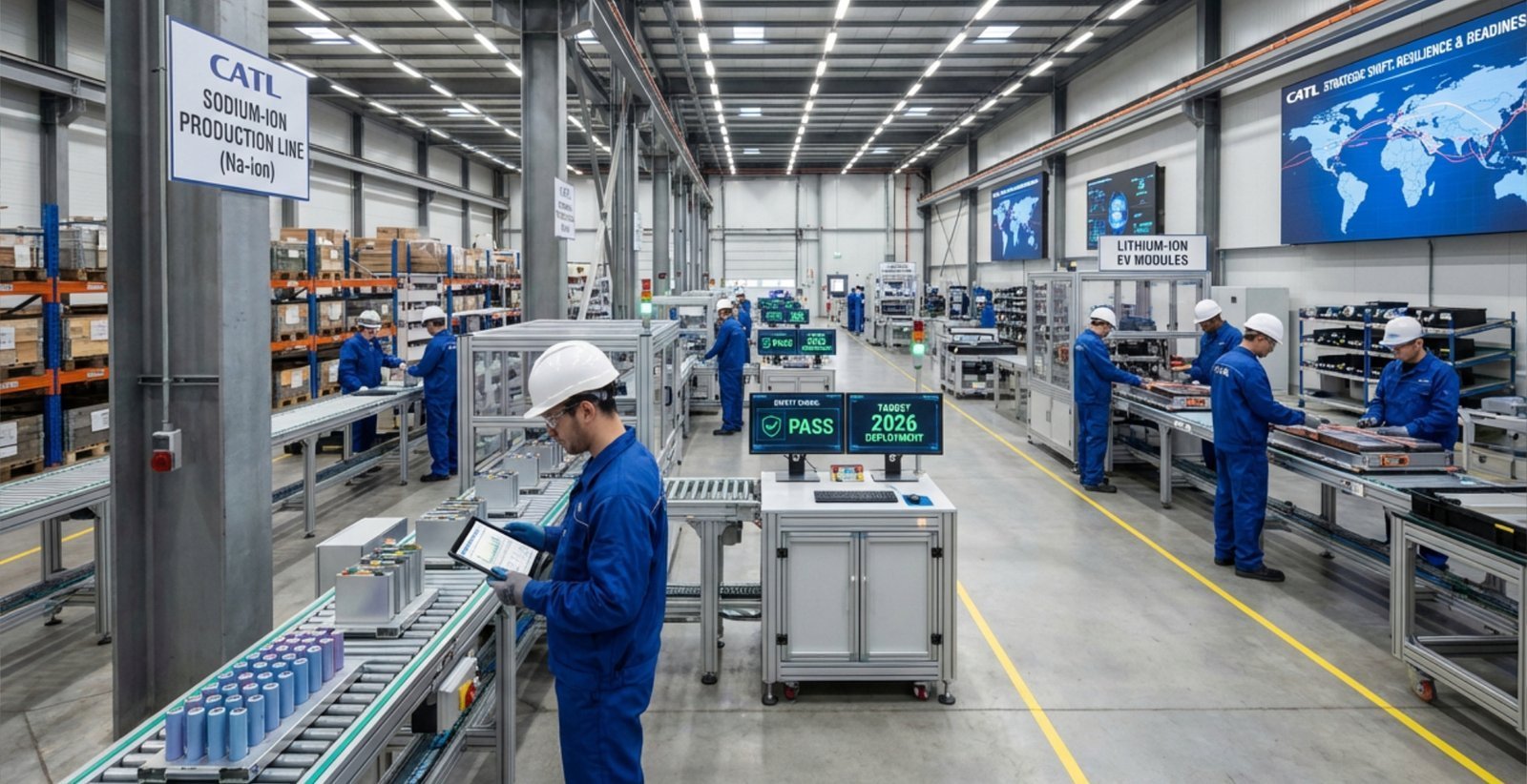
At a supplier conference in late December 2025, CATL confirmed that its sodium-ion battery technology will be ready for large-scale, multi-sector deployment by end-2026.
Planned applications include:
- Passenger electric vehicles
- Commercial vehicles
- Battery swapping platforms
- Grid-scale and distributed energy storage
This breadth underscores CATL’s intent to position sodium-ion not as a niche alternative, but as a mainstream battery platform.
Naxtra: CATL’s Sodium-Ion Battery Brand
In April 2025, CATL introduced Naxtra, its dedicated sodium-ion battery brand. The company reports that Naxtra cells achieve an energy density of 175 Wh/kg, approaching the performance of leading lithium iron phosphate (LFP) batteries.
Key performance attributes include:
- Operating temperature range: –40°C to +70°C
- Improved cold-weather range and charging stability
- Enhanced thermal safety profile, comparable to or exceeding LFP
CATL has stated that vehicles equipped with sodium-ion batteries can achieve over 500 km of pure electric driving range, reinforcing their commercial viability.
Regulatory and Safety Leadership
CATL’s Naxtra batteries are the world’s first sodium-ion batteries to pass China’s GB 38031-2025 Electric Vehicle Traction Battery Safety Requirements, the country’s most stringent EV battery safety standard.
These regulations will take effect on July 1, 2026, giving CATL a first-mover advantage as OEMs race to comply with next-generation safety benchmarks.
Strategic Implications for the EV Industry
1. Reduced Lithium Dependency
Sodium-ion chemistry significantly lowers reliance on lithium, a material exposed to geopolitical risk, price volatility, and long-term supply constraints.
2. Cost and Supply-Chain Resilience
Sodium is abundant and geographically diversified, offering greater price stability and supply security-critical for scaling EV adoption globally.
3. Cold-Climate Electrification
Superior low-temperature performance positions sodium-ion batteries as a breakthrough enabler for EV adoption in colder regions, logistics fleets, and heavy-duty applications.
4. Energy-System Flexibility
By supporting EVs, swapping networks, and stationary storage, CATL is aligning battery innovation with grid resilience and energy security goals.
Falling lithium-ion battery costs reshaping EV and energy storage economics read more
Leadership Perspective
CATL frames sodium-ion technology as a step toward “energy freedom”, shifting the industry from dependence on a narrow set of critical minerals to a more diversified and resilient energy foundation.
For C-level executives, this development warrants close attention:
- Automakers must reassess long-term platform strategies
- Utilities and grid operators gain a safer storage alternative
- Policymakers see a path to decouple electrification from mineral bottlenecks
Outlook: 2026 and Beyond
If CATL delivers on its deployment timeline, sodium-ion batteries could emerge as a third pillar of EV energy storage, alongside LFP and NMC chemistries.
The next phase of competition will not be defined solely by energy density-but by safety, resilience, total cost of ownership, and supply-chain control.CATL’s sodium-ion strategy suggests that the future of EV batteries may be less about scarcity-and more about systems thinking.