The cleanest graphite in the world still needs a coat.
Before natural graphite can work as active anode material in a lithium-ion cell, it has to be shaped, purified and wrapped in a thin carbon layer. For years the standard material for that layer has been pitch. On October 7, 2026, Nouveau Monde Graphite (NMG) said it has developed a replacement with researchers at McGill University: a bio-based, green-chemistry coating process that matched pitch on the measures cell makers care about in laboratory testing.
According to NMG, replacing pitch with the bio-based coating could cut Scope 1 emissions by 130 kg of CO2e per tonne of coated spherical purified graphite (CSPG). The company has filed a patent application and holds exclusive commercial rights to the technology.
It is a small step in the process. It could matter a great deal to the business case for Canadian anode material.
Coating Is Where Anode Material Earns Its Value
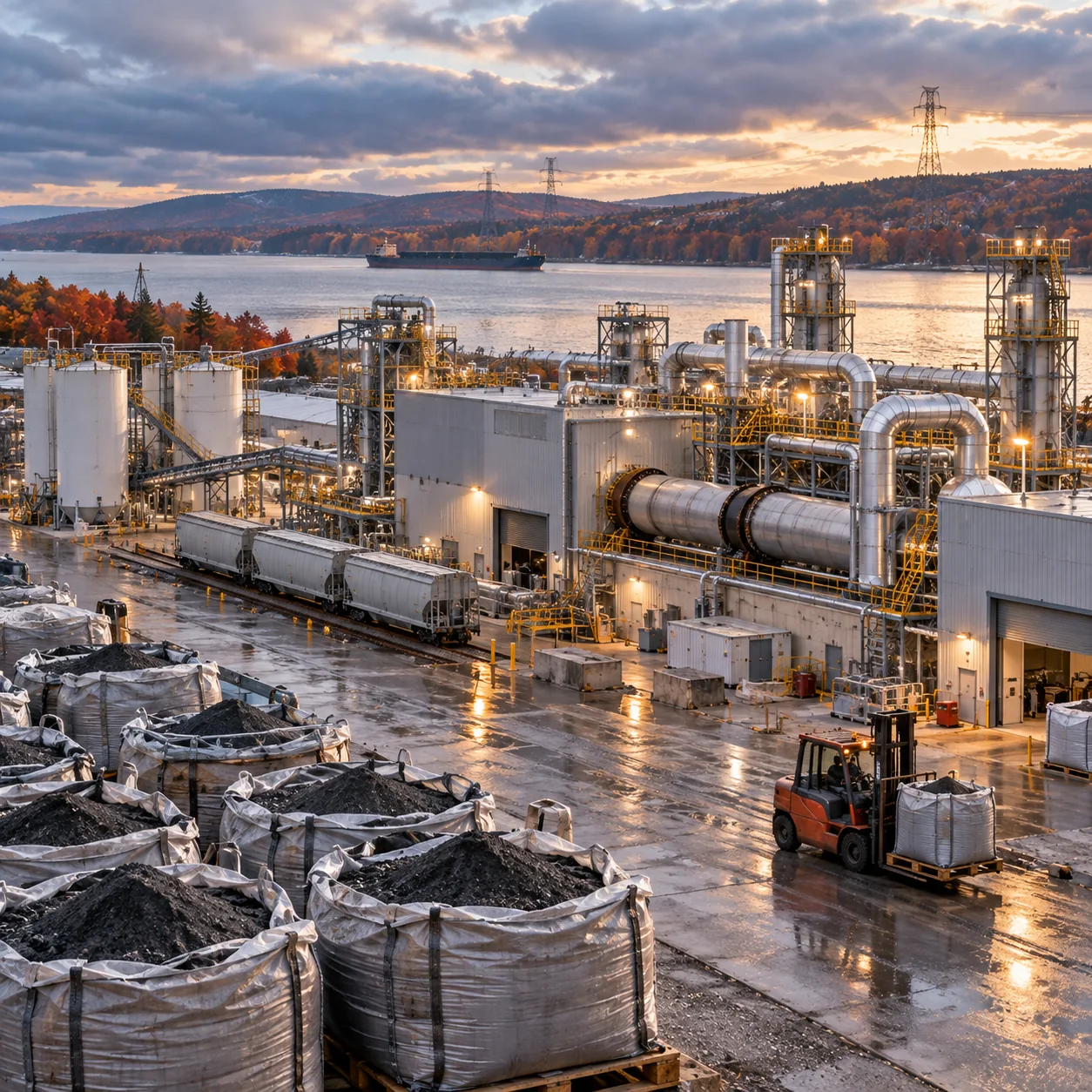
Coating gets less attention than mining or purification, but it is one of the steps that makes graphite usable in a battery. In earlier descriptions of its program, NMG explained that the coating step lays a nanoscale layer of amorphous carbon on purified spherical graphite. That lowers the material’s specific surface area and improves its electrochemical performance.
So the real test for any substitute is whether the cell can tell the difference.
NMG says electrochemical testing showed the bio-based coating delivered equivalent performance in capacity, first-cycle efficiency and fast charging. The company also says the process uses bio-based materials that work with existing manufacturing equipment. For a plant still in engineering, that point matters. A lower-carbon input that needs a different kiln line would be a far harder sell than one that drops into a standard flowsheet.
Six Years of Quebec Research Behind One Announcement
The collaboration with McGill began in 2020. The work was supervised by Professor Philippe Ouzilleau, with contributions from Professors Changhong Cao, Raynald Gauvin, Jinhyuk Lee, Sidney Omelon and Sylvain Coulombe. Québec’s Mining Research and Innovation Support Program (PARIDM) provided early funding, followed by a grant from the Natural Sciences and Engineering Research Council of Canada (NSERC).
That is how a domestic materials industry should work. Public research money, a university lab and a company with a plant to build stayed on one problem long enough to reach a patentable result.
Eric Desaulniers, NMG’s Founder, President and CEO, expressed pride in the work accomplished by NMG’s R&D team and in the successful collaboration with McGill University, a world-renowned institution, to develop this new coating process for anode materials.
The Timing Lines Up With Bécancour
The announcement comes as NMG moves its integrated Quebec project from development into execution. Construction is under way at the Matawinie Mine, which the company describes as set to become Canada’s largest natural graphite operating mine. Downstream, NMG is targeting a final investment decision in the coming months on its 13,000-tonne-per-year Bécancour Battery Material Plant, a brownfield site about 160 km from the mine.
The financial base is taking shape. In its second-quarter update, NMG reported a C$427 million equity financing package, a US$335 million debt commitment, a government take-or-pay commitment for 30,000 tonnes per year of flake graphite, and a potential 15,000-tonne-per-year concentrate offtake with Eni. It put the Bécancour plant’s capital cost at C$374 million and ended June with C$461 million in cash.
On the commercial side, Panasonic Energy signed a binding offtake agreement in October 2025. NMG says Panasonic has reiterated its intent to support the project, which may include an equity investment at FID. Investissement Québec, the Canada Growth Fund and Eni are among the equity backers, with Export Development Canada and the Canada Infrastructure Bank listed on the debt side.
A lower-carbon coating process gives that group of partners another reason to care about what comes out of Bécancour.
Carbon Intensity Is Becoming a Procurement Line Item
Automakers and cell makers are writing carbon footprint and traceability terms into supply contracts. European battery rules are pushing in the same direction. For anode suppliers, competition is shifting from price and purity alone to how much carbon is embedded in each tonne.
Quebec already starts with hydroelectric power, and a bio-based coating takes out a direct emissions source that clean electricity cannot touch. That pairing could set North American anode material apart from incumbent supply, which is still concentrated in China.
For buyers weighing a North American anode contract, the questions are practical:
- Does the material qualify on capacity, efficiency and fast charging without changes to cell design?
- Can the supplier document Scope 1 savings per tonne in a form auditors accept?
- Will the coating run on standard industrial equipment at commercial volumes?
- How does long-term cycling compare with pitch-coated material?
- Are bio-based precursor supplies secure at plant scale?
From the Lab Bench to an Industrial Kiln
NMG is clear that the results so far are at laboratory scale. The company says the next steps toward industrialization include comparative long-term cycling tests, evaluation of new material types and, ultimately, a validation campaign on industrial-scale equipment.
That sequence is the right one.
Cell qualification is slow and unforgiving. Equivalent first-cycle results are encouraging, but customers will want cycle-life data that holds up over hundreds of cycles before they sign off on a change of coating. The fact that the process works with existing equipment should shorten the path, because qualification can focus on the material rather than on new hardware.
For investors, the technology adds to the Bécancour story without adding to its capital cost. For policymakers, it is a working example of Canadian research funding turning into intellectual property owned by a Canadian battery materials company. For cell makers, it could become a credible low-carbon anode option sourced inside the continent.
Canada spent years trying to prove it could mine battery minerals. The next test is whether it can process them better than anyone else, and a cleaner coating is a good place to start.