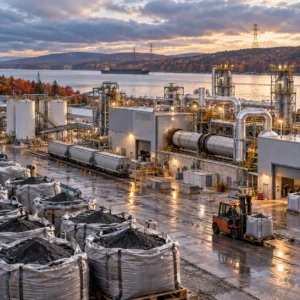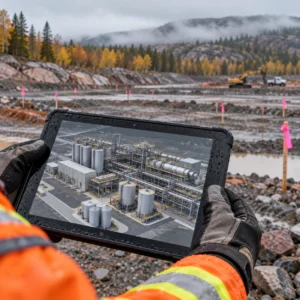
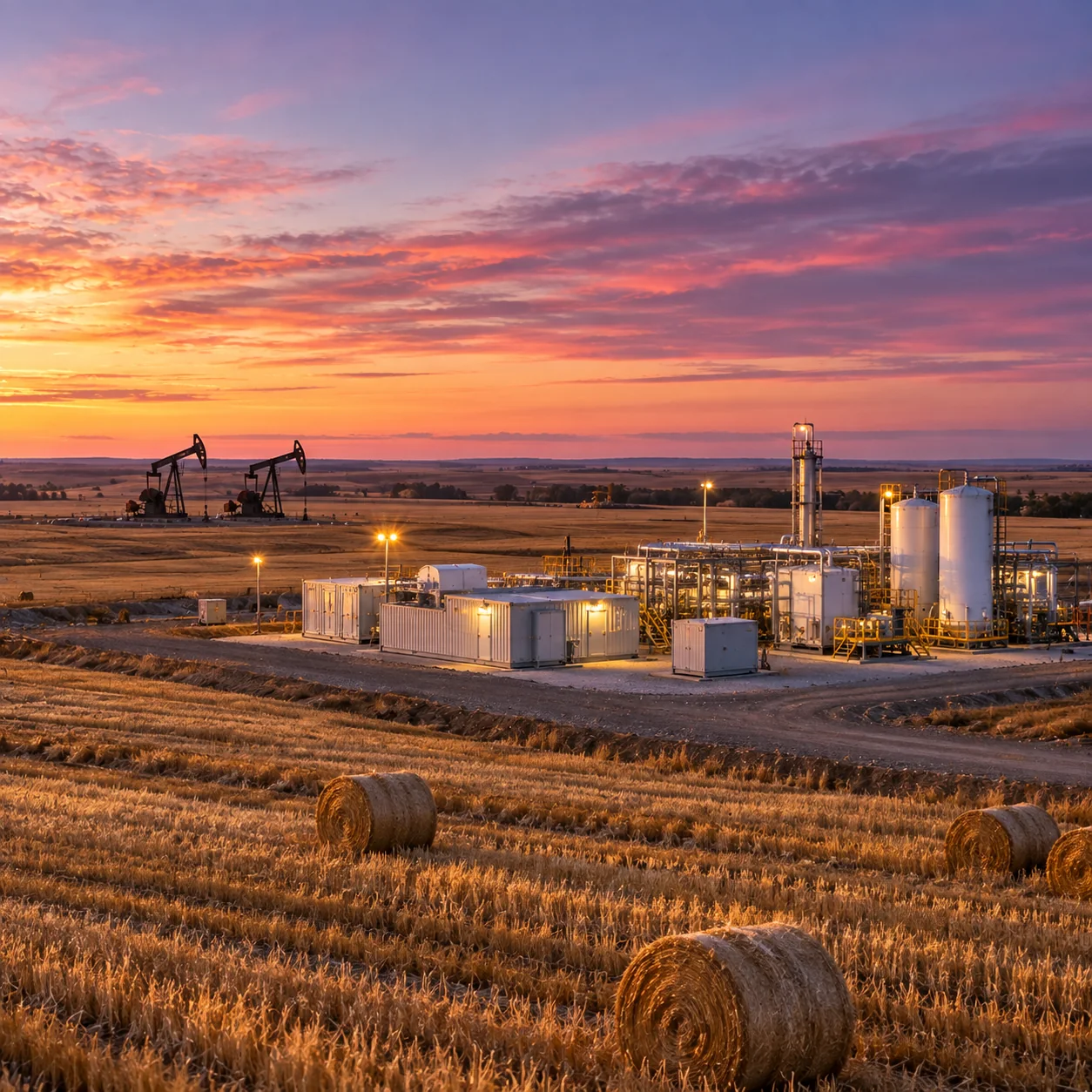
Canada’s lithium story has a new address, and it sits under the old oil fields of central Alberta.
On September 29, E3 Lithium released a status update on its Clearwater Project in the Bashaw District between Red Deer and Calgary. The update covered every major workstream: the demonstration facility, engineering, permitting and commercial discussions. All of them moved forward.
According to the company, Phase 2 of its demonstration facility is nearing completion, a licence application has been submitted for the Clearwater Central Processing Facility, and front end engineering design (FEED) is targeted for completion in 2027. E3 also signed two non-binding memorandums of understanding with buyers in India and the United Kingdom.
For a country trying to build a battery supply chain from the ground up, that combination matters.
A Brine Resource Built on Oilfield Geology
Most of the lithium conversation in Canada has centred on hard rock spodumene in Quebec and Ontario. Clearwater is a different model. E3 is extracting lithium from brine held in the Leduc reservoir, the same formation that powered decades of Alberta oil production.
The scale is significant. E3 reports a total of 21.2 million tonnes of lithium carbonate equivalent (LCE) in Measured and Indicated resources, with 16.2 million tonnes at Clearwater at an average grade of 75.5 mg/L. The company’s pre-feasibility study set out a proven and probable reserve of 1.13 million tonnes LCE and planned production of roughly 30,000 tonnes per year of battery-grade lithium carbonate.
The economics in that study are equally notable: an after-tax net present value of US$3.7 billion at an 8% discount rate and an after-tax internal rate of return of 24.6%.
Numbers on paper are one thing. Proving the process is another.
The Demonstration Facility Is Doing the Hard Work
Direct lithium extraction (DLE) has long promised a faster, lower footprint route to battery-grade lithium. The challenge has always been showing that it works reliably at commercial scale on a specific brine.
E3’s approach has been staged. Phase 2 of the demonstration facility is generating the data that now feeds commercial facility design. Phase 3 will deploy a commercial-scaled DLE column, with operations expected through 2027 and potentially beyond.
That sequence is what lenders, offtakers and engineering firms want to see. Each phase narrows technical uncertainty before the large capital commitments arrive.
“Each of Clearwater’s key workstreams is moving forward: the Demonstration Facility is entering its final phase, engineering and FEED is advancing on the strength of Phase 2 results, and [E3’s] offtake discussions continue to broaden,” said Chris Doornbos, CEO and Chair of E3 Lithium.
Engineering and Permitting Are Advancing Together
The update also points to a more disciplined project delivery path. E3 says engineering and technical capacity is expanding with support from an EPC contractor, with FEED completion targeted for 2027.
In parallel, the licence application for the Clearwater Central Processing Facility has been submitted.
Running these workstreams side by side is how critical minerals projects shorten the gap between promising resource and producing asset. Delays in North American battery materials projects have rarely come from geology alone. They come from permitting queues, engineering rework and financing gaps that open when one workstream waits on another.
Clearwater also carries federal backing. Natural Resources Canada has committed up to $36.5 million in non-repayable funding through its Global Partnerships Initiative.
Offtake Interest Is Reaching Beyond North America
The commercial side of the update may be the most telling.
E3 signed a non-binding MOU with India-based Epsilon CAM covering long-term supply of battery-grade lithium carbonate, and another with UK-based Tees Valley Lithium aimed at access to the European hydroxide market.
Neither agreement is binding. Both are signals.
Cathode producers and refiners outside China are actively looking for lithium supply from stable jurisdictions with transparent permitting and strong environmental standards. An Alberta brine project with federal support and a staged technical record fits that profile.
For Canada, that is a useful reminder: domestic lithium does not have to serve only domestic demand to strengthen the national value chain. Export relationships with allied markets can anchor the financing that eventually supports local conversion and cathode capacity too.
What Developers and Investors Should Watch
Clearwater is still a development project, and the next 18 months will define how quickly it moves toward a construction decision. The milestones that matter most are clear:
- Completion of Phase 2 and the start of the commercial-scaled DLE column in Phase 3
- Progress on FEED toward its 2027 target
- Regulatory decisions on the Central Processing Facility licence
- Conversion of non-binding MOUs into binding offtake agreements
- Project financing structure, including government and export credit participation
- Integration with downstream conversion and cathode capacity in North America
For utilities and industrial planners in Alberta, the project also raises a broader opportunity. Oilfield skills, subsurface data and existing infrastructure can be redirected toward battery materials, turning a legacy energy region into a supplier for the electrified economy.
Alberta Is Making a Case for Brine
Canada’s battery strategy has leaned heavily on cell plants and hard rock mining. Clearwater adds a third leg: brine-based lithium using DLE, developed in a province with deep subsurface expertise.
If E3 delivers on its demonstration and engineering milestones, the project could give North American and allied buyers a new source of battery-grade lithium carbonate that does not depend on traditional evaporation ponds or overseas refining.
The resource has been in the ground for millions of years. What is changing is the proof that it can be produced at scale.