Canada’s lithium challenge has never been a shortage of rock.
The gap sits in the middle of the value chain, between the mine and the cathode plant, where mineral concentrate has to become battery-grade chemicals. North America has very little of that conversion capacity. Projects that want to fill the gap all face the same test: they have to prove their design will work before lenders and offtakers commit serious capital.
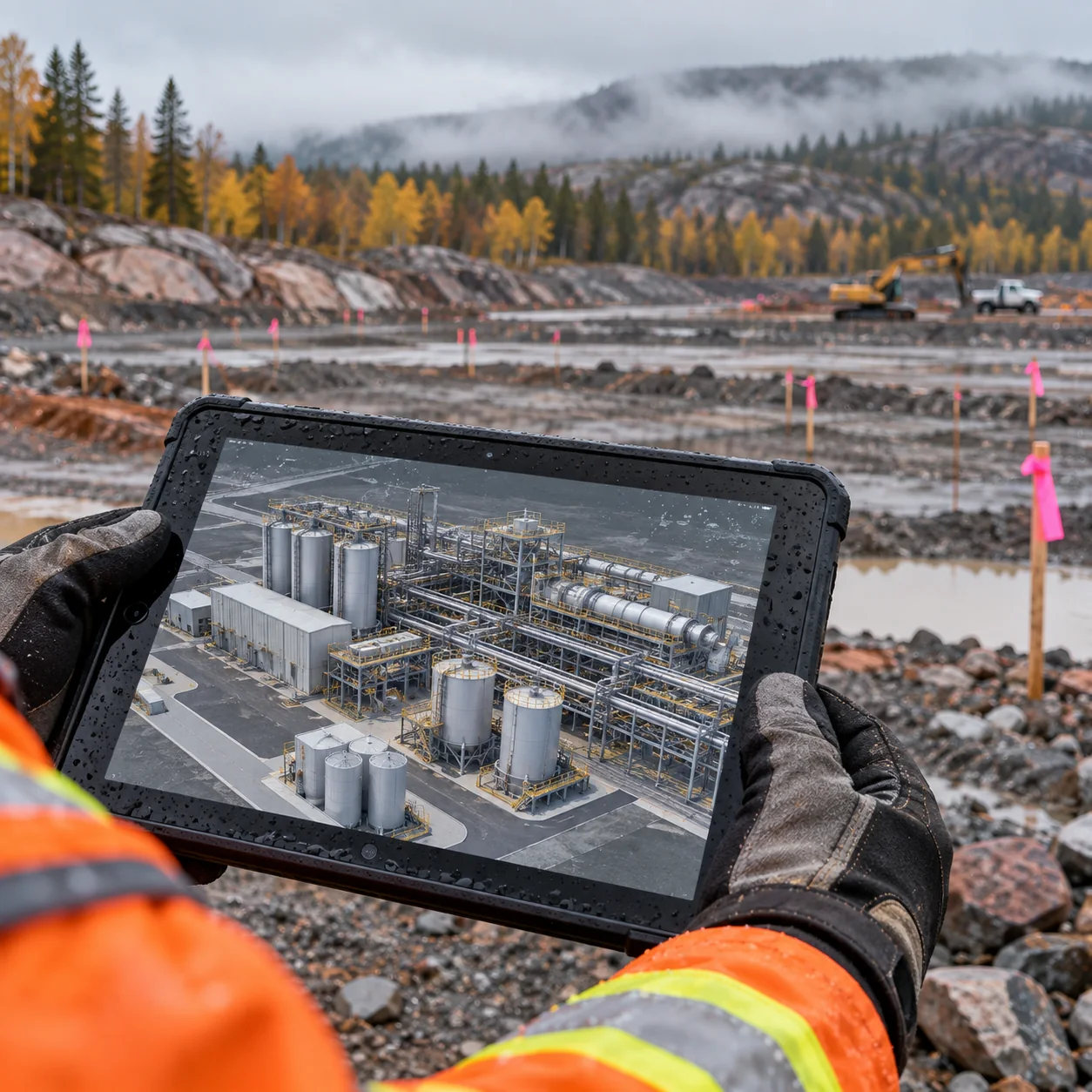
On September 22, Rock Tech Lithium took a concrete step toward passing that test. The company signed agreements with Siemens Canada to build a digital process twin of its planned Red Rock Lithium Converter in northwestern Ontario. Siemens will also support the project’s definitive feasibility study.
Rock Tech says the converter is designed for up to 32,000 tonnes a year of lithium carbonate equivalent. That would make it a meaningful piece of domestic refining capacity for a region trying to build its battery supply chain at home.
The Converter Is the Missing Link in Ontario’s Lithium Chain
Ontario has spent years assembling the downstream end of the battery industry, and the northwest of the province holds hard-rock lithium deposits. What connects the two is a chemical conversion step that, for the most part, does not yet exist in Canada at commercial scale.
According to MRO Magazine, Red Rock is intended to turn lithium feedstock into battery-grade materials for North American electric vehicle and energy storage markets. Rock Tech plans to source feed from its wholly owned Georgia Lake Project, supplemented by ESG-compliant suppliers. The company also plans to integrate recycled materials, with the stated aim to “close the local battery loop.”
That design choice matters.
A converter that can take both mined concentrate and recycled feed is better protected against swings in any single supply stream. It also fits the traceability and recycled-content requirements that buyers on both sides of the Atlantic increasingly expect.
A Virtual Plant Comes Before the Real One
The agreements are the first implementation phase of a memorandum of understanding the two companies signed earlier in 2026. Their main deliverable is a physics-based virtual model of the plant’s processes, energy flows and material streams.
Rock Tech says the model will let it test, optimise and validate design choices before major capital is committed. MRO Magazine reports that the twin is meant to support the project “through its full lifecycle, from feasibility and engineering through construction and operations.” Siemens Canada will also contribute expertise in process control, instrumentation and automation architecture for the feasibility study.
In practical terms, design flaws that would normally surface during commissioning, when fixing them is slow and expensive, can be found and corrected while the plant is still being designed.
Reducing Risk Is the Real Deliverable
Rock Tech launched the definitive feasibility study at the end of June 2026 and expects to complete it by mid-December. That study is the document financiers, governments and customers will use to judge the project.
Chemical conversion is the stage where lithium projects come under the closest scrutiny. Every buyer and every lender wants the same two answers:
Will the plant reach its design capacity on schedule?
Will it hit battery-grade specifications consistently?
A feasibility study backed by a validated process model can answer both with more evidence than spreadsheets alone. For a developer looking for financing, that evidence can shape the cost of capital and the terms of offtake contracts. For anyone tracking Canadian refining projects, a few markers are worth watching:
- Whether the feasibility study arrives on its mid-December 2026 target
- How much of the plant’s design is validated in the twin before engineering is locked
- Energy and emissions results from the model, which affect operating cost and buyer requirements
- How recycled feed is built into the process design
- Offtake and financing commitments that follow the feasibility study
German Engineering Meets Canadian Feedstock
The partnership also has a wider industrial logic. Rock Tech is developing a converter in Guben, Germany, with capacity of 24,000 tonnes a year of lithium hydroxide monohydrate. That project has been recognised as a Strategic Project under the EU Critical Raw Materials Act.
Rock Tech presents the Siemens agreements as a way to bring German lithium conversion and industrial digitalisation expertise to Canadian resources, with the broader goal to “build resilient lithium supply chains for the G7.”
The framing fits the moment. Allied economies want lithium chemicals that do not depend on a single dominant refining country, and they want the processing know-how to travel with the capital. A converter designed with tools that can be reused at other sites gives that cooperation a practical template rather than a political slogan.
Execution Will Decide Canada’s Refining Future
None of this replaces the hard steps still ahead. Red Rock still needs a completed feasibility study, a financing package, permits and a construction programme before it produces a tonne of product.
What the Siemens agreements change is the quality of the information behind those decisions. Canadian battery projects have learned that announcing capacity is easy and delivering it is not. A plant that has been tested in simulation before steel goes in the ground starts with fewer unknowns.
That makes the coming months important. If Rock Tech delivers a credible feasibility study on schedule, Red Rock becomes a strong case for a domestic conversion industry built on disciplined engineering rather than optimism.
Ontario already has the rock and the factories. Red Rock is an attempt to build the bridge between them on screen first, and in steel second.