
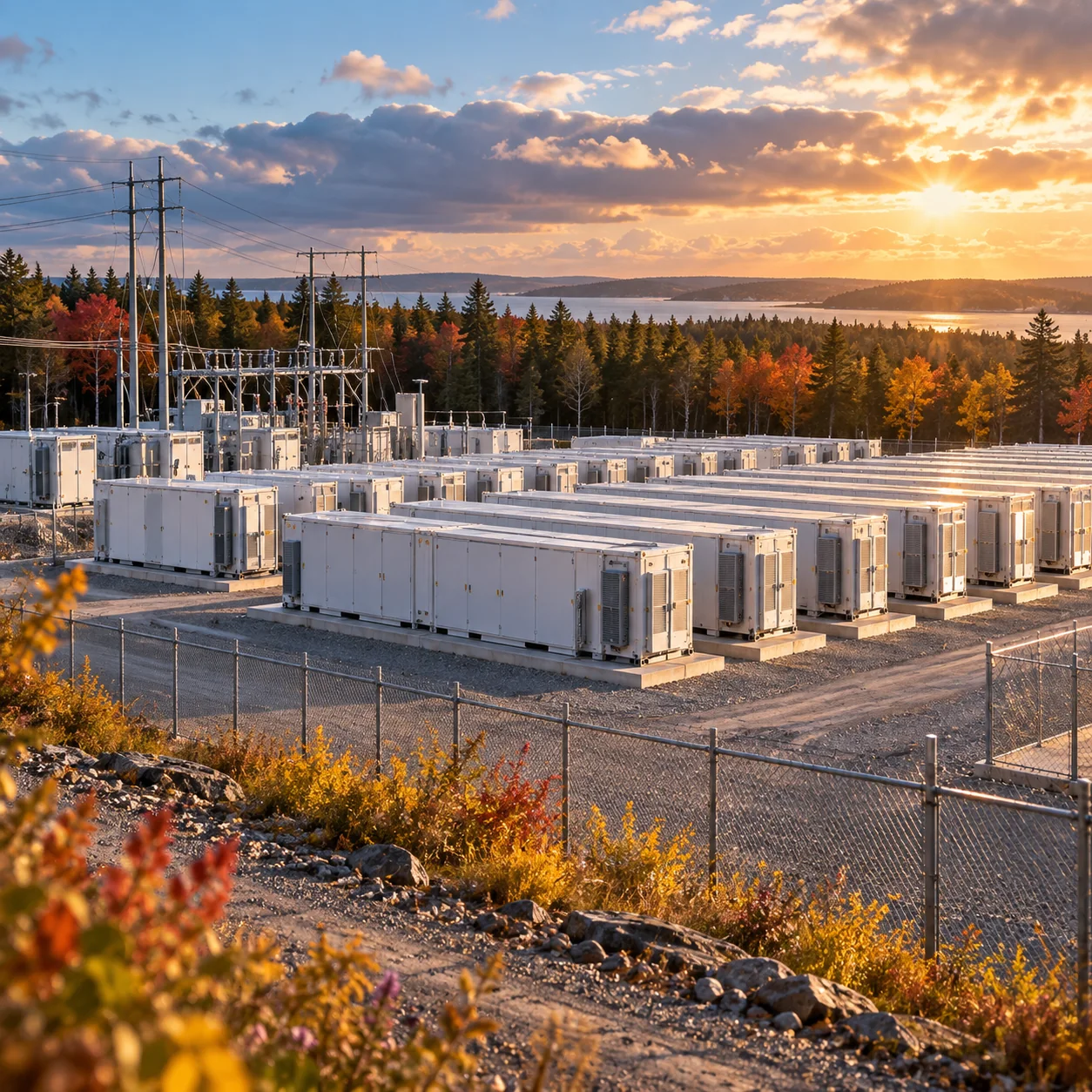
Atlantic Canada’s largest battery fleet is now officially in service.
On September 16, federal officials met Nova Scotia Power, the Canada Infrastructure Bank and the Wskijinu’k Mtmo’taqnuow Agency (WMA) in Waverley to open three battery energy storage systems in Bridgewater, Waverley and White Rock. Each site is rated at 50 MW/200 MWh. Together they give the province 150 MW and 600 MWh of grid storage. According to Natural Resources Canada, that makes them the largest facilities of their kind in Atlantic Canada.
Ottawa put $109 million toward predevelopment and installation, and the Canada Infrastructure Bank lent $138.2 million. Through the WMA, all 13 Mi’kmaw communities in Nova Scotia are equity partners in the project.
Most battery coverage focuses on electric vehicles, but this is a different kind of demand. A utility is buying batteries as core grid infrastructure, financing them over the long term and sharing ownership with local communities.
Storage Has Moved From Pilot to Grid Asset
The three sites came online in stages. Nova Scotia Power says Bridgewater and Waverley were energized in late 2025 and declared operational at the end of January 2026. White Rock was scheduled to follow in August.
The first two sites proved useful quickly. Nova Scotia Power says they served as “reliable backup power sources during periods of high peak demand” during the cold snaps that hit the province in late January.
That matters.
Winter peaks are when grid operators carry the most risk. A battery that performs through a cold-weather peak makes a stronger case to regulators than any modelling study. Natural Resources Canada says each site can power roughly 45,000 average homes for four hours during peak demand or an outage.
The department also expects the projects to cut greenhouse gas emissions by about 90,000 tonnes a year. They do this by storing mainly non-emitting energy and helping the grid absorb more wind power.
Batteries Are Now Part of the Renewables Plan
Nova Scotia Power has tied the project to the province’s target of 80% renewable electricity by 2030. Wind output rises and falls with the weather. Storage lets the system operator decide when that energy reaches customers.
“These projects strengthen the reliability of the electricity system for our customers while enabling the continued growth of renewable energy,” said Vivek Sood, President and CEO of Nova Scotia Power.
Tim Hodgson, Minister of Energy and Natural Resources, made a similar point: “Clean electricity will ensure that we can keep that energy reliable, affordable, and secure.”
For the wider battery value chain, the message is that grid storage is now sold on reliability as much as on emissions. Reliability is what regulators approve and what ratepayers end up paying for.
The Financing Structure Is the Real Template
How the project was paid for is as instructive as the equipment. It combines federal support, a large loan from a public infrastructure lender and Indigenous equity. Natural Resources Canada points to the $4.5 billion Smart Renewables and Electrification Pathways Program and the $250 million Electricity Predevelopment Program as the federal tools behind this kind of build.
“Energy storage is part of our path toward a greener future, and our First Nations need to be part of this ongoing transition,” said Crystal Nicholas, President and General Manager of the WMA.
Ontario is following the same pattern at a larger scale. ESS News reported in June that the Independent Electricity System Operator had selected three projects totalling 640 MW of eight-hour battery storage. Each project has a 50% Indigenous ownership stake, and the province’s total procured utility-scale storage has reached about 3.6 GW.
Indigenous ownership is becoming a standard feature of Canadian grid storage.
A Steadier Source of Demand for the Supply Chain
Behind the ribbon cutting is a supply contract. In July 2024, e-STORAGE, the storage business of Canadian Solar, announced that Nova Scotia Power had hired it for the three sites. The contract covers engineering, procurement and construction, plus long-term service agreements.
Those service agreements keep the supplier tied to each asset for years. That covers performance, degradation management and eventually decommissioning. Over time, utility storage fleets also become a predictable source of material for domestic recyclers.
For developers, suppliers and investors, the Nova Scotia project offers several practical lessons:
- Cold-weather performance data is now a selling point in Canadian procurement
- Indigenous equity partnerships are increasingly expected rather than optional
- Public lenders such as the CIB can carry a large share of project debt
- Long-term service agreements turn one-time equipment sales into multi-year relationships
- Provinces are buying both four-hour and eight-hour storage
- Retired grid batteries will become feedstock for North American recycling
The Next Test Is Repetition
At 600 MWh, Nova Scotia’s fleet is small next to Ontario’s procurement pipeline. Its value lies elsewhere. It shows that a smaller utility can finance, build and operate grid-scale storage with community owners, and that the assets perform when demand peaks.
The open question is how quickly other provinces and utilities copy the model. Each repeat would add steady, contracted demand for cells, systems, integration services and, eventually, recycling capacity across North America.
Nova Scotia has shown its batteries can carry a winter peak. The next step is making that ordinary across the country.