Canadian LFP cathode material is now in the hands of the customers who decide whether it gets bought.
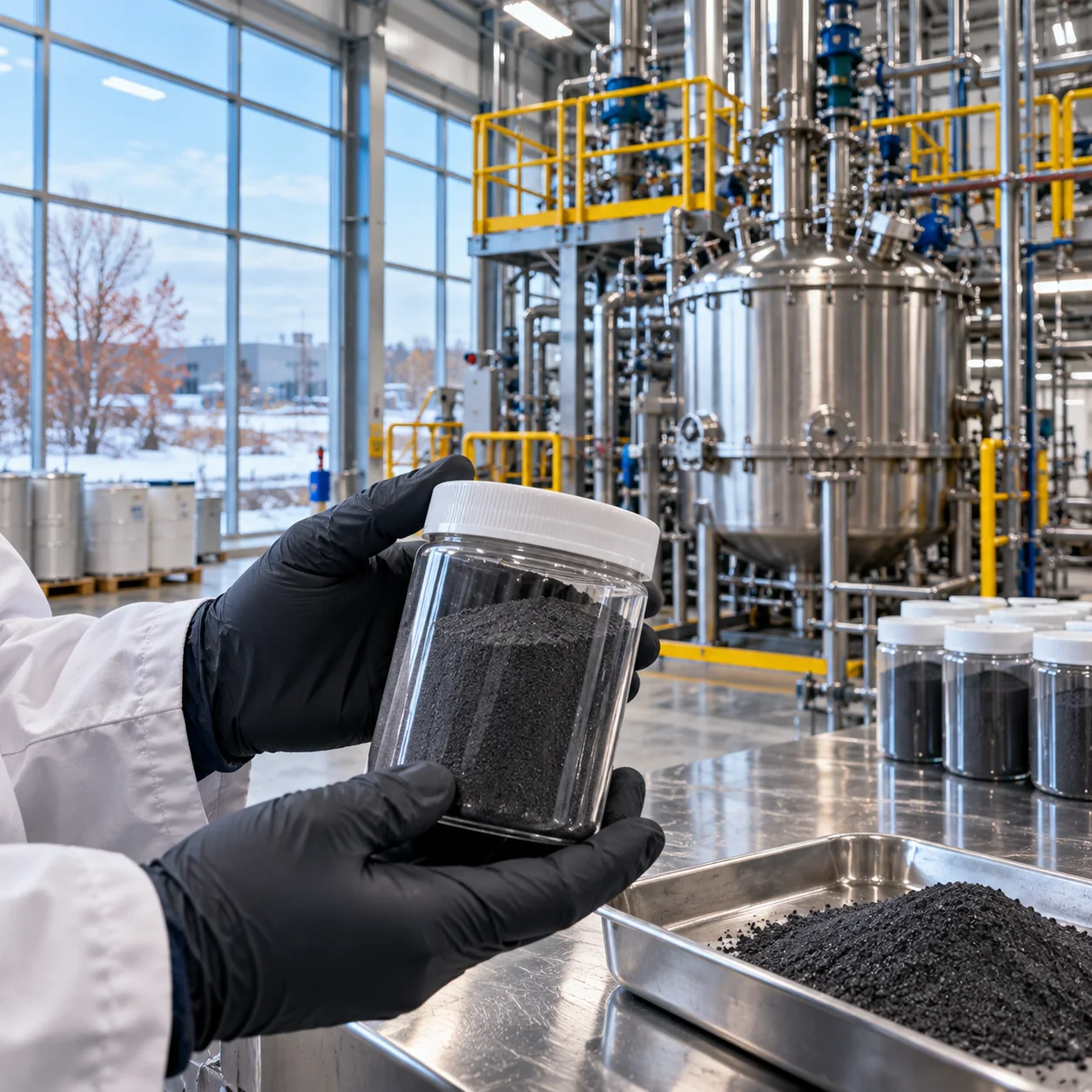
Nano One Materials said on October 20, 2026 that Sumitomo Metal Mining has supplied One-Pot LFP samples to its cell manufacturer and automaker customers, and that those customers have given positive feedback. Sumitomo Metal Mining is a strategic project partner under Nano One’s programs funded by Natural Resources Canada.
Sampling is not a supply contract. It is the stage that comes before one, and for a new cathode producer it is often the hardest door to get through.
Customer Feedback Is the Milestone That Counts
Battery materials are qualified slowly. Cell makers test samples, then larger batches, then production-intent material, before they sign offtake agreements. Nano One describes the latest step as part of a multi-step qualification pathway that leads toward commercial offtake.
“Our customers have provided positive feedback on samples produced through the One-Pot process,” said Munekazu Kawata, Managing Executive Officer and General Manager of Sumitomo Metal Mining’s Battery Materials Division.
The company also reports that its latest-generation LFP cathode has reached a pressed density suitable for high-performance cell producers. For a cathode supplier, meeting the specifications that cell producers set is what earns a place in their testing programs.
That matters for credibility.
A Japanese materials group with established cell and automaker customers is carrying the product to market, rather than a developer approaching buyers alone.
A Process That Skips the Precursor Bottleneck
The case for Nano One rests on how its material is made.
Conventional LFP plants buy iron phosphate precursor and react it with lithium carbonate. Nano One’s patented One-Pot process makes LFP cathode directly from lithium carbonate, iron and phosphoric acid, and it accepts a range of iron inputs. In an October 8, 2026 update, the company cited IEA data showing that China holds over 95% of precursor cathode material.
Removing the precursor step moves sourcing back to the raw-material level, where North American and allied suppliers can compete. Nano One reports three pre-qualified lithium carbonate suppliers, three pre-qualified phosphoric acid suppliers, and a Canadian iron oxide supplier advancing toward tonne-scale validation, with further suppliers in Canada and the United States moving through pre-qualification.
“Iron is seemingly everywhere, but the right purity, located and sourced from the right regions, simply isn’t,” said Denis Geoffroy, Chief Operating Officer of Nano One.
The Cost Case Gets a Number
Sampling also came with an economic estimate. Based on Sumitomo Metal Mining’s internal modelling, Nano One estimates potential conversion cost savings of up to US$1 million per year for every 1,000 tonnes per annum of capacity, using a three-year average exchange rate of ¥152 to the US dollar.
For LFP, a chemistry chosen largely for its economics, that kind of saving carries weight. Geoffroy said he believes the result will further enhance the value proposition to potential customers, licensees and joint venture partners.
Candiac Builds the Bridge to Commercial Scale
The physical base for all of this is Nano One’s facility in Candiac, Québec.
The existing pilot line produces about 200 tonnes per annum. In July 2026 the company said detailed engineering for a demonstration line expansion was 85% complete, taking total facility capacity to about 800 tonnes per annum. Commissioning is expected in the first half of 2027, and about 95% of equipment by procurement cost is sourced from Canada, the United States and the European Union.
Candiac is designed to produce the larger C-sample batches that customers typically require before signing bigger offtake contracts. Beyond that, Sumitomo Metal Mining and Nano One continue to work toward a large-scale LFP production facility in Canada, subject to securing customer offtake, project financing and government funding.
Federal support is already in the structure. Sumitomo Metal Mining participated as an in-kind partner under Nano One’s C$9.3 million Energy Innovation Program funding from Natural Resources Canada, and has contributed testing and external validation to a separate C$3 million NRCan LFP supply chain initiative.
What Canadian Buyers and Investors Should Watch
The next steps are clear, and each one is measurable:
- Results from customer evaluations of the latest samples
- Commissioning of the Candiac demonstration line in the first half of 2027
- C-sample batches delivered to cell makers
- Completion of iron oxide validation with Canadian supply
- Offtake commitments that support a large-scale Canadian plant
For Canada, the opportunity is specific. The precursor supply behind LFP sits overwhelmingly in one country, according to the IEA figures Nano One cites. A domestic process that bypasses that precursor, backed by a global materials partner, gives the country a credible route into the cathode market without simply copying the incumbent model.
Qualification is slow by design. Nano One has now reached the part of it where the customers are doing the testing.